Professional Aesthetic SolutionsYOUR BEAUTY SECRETGlobal Professional PartnershipsBLOOM Planet — United Kingdom
Home/Signature of BLOOM/Hyalu Tox PDRN
Hyalu Tox
01Skin Rejuvenation

Hyalu Tox PDRN

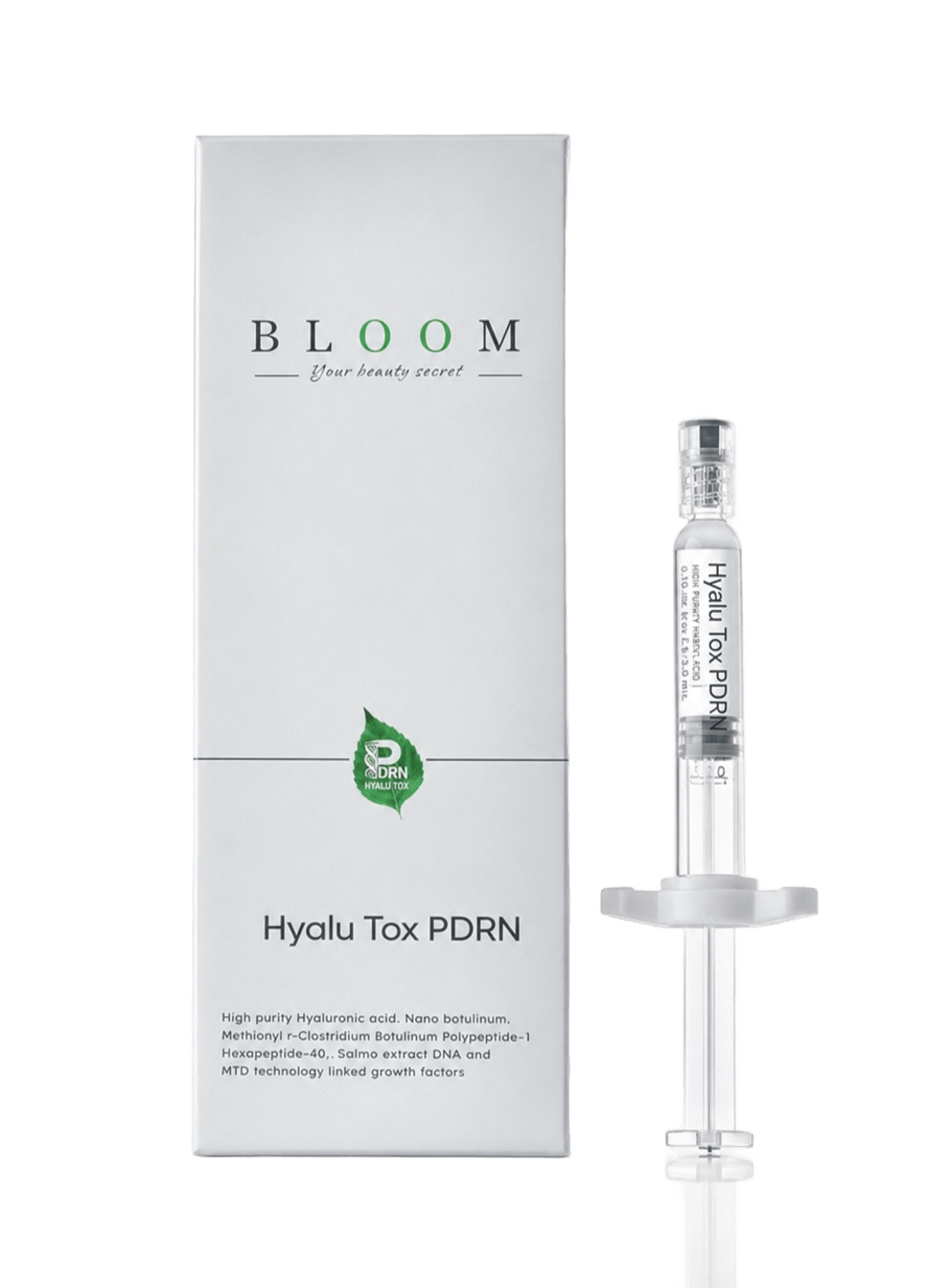
Hyalu Tox PDRN combines Methionyl r-Clostridium Botulinum Polypeptide-1 Hexapeptide-40, salmon-derived DNA/PDRN, tranexamic acid and a 3D hyaluronic-acid system.

Explore Product
Hyalu Tox PDRN

Product facts,
at a glance.

Key product information, composition and technical specifications.

01Core ingredientMethionyl r-Clostridium Botulinum Polypeptide-1 Hexapeptide-40
02PDRN sourceSalmon extract DNA / PDRN
03Additional activeTranexamic acid
04HA systemHigh-purity 3MDa hyaluronic acid with three molecular-weight ranges
05Supporting ingredientsTrehalose, Arginine and Glutathion
06ICIDRegistered in the International Cosmetics Ingredient Dictionary in December 2014; ICID 2016 Vol.2, p.2096.
07PCT referencePCT/KR2015/005434

Ingredients &
technology.

01

MTD + botulinum light-chain concept

Methionyl r-Clostridium Botulinum Polypeptide-1 Hexapeptide-40

a recombinant protein combining an MTD (Macro-molecule Transmission Domain) with an active botulinum toxin light-chain component.

vector pET21b, an MTD insert of approximately 20 amino acids, a Clostridium botulinum neurotoxin type A light chain of 447 amino acids, sequence from Clostridium botulinum type A Hall Lc, and a hexa-histidine tag.

a molecular weight of 50 kDa for BLOOM/BPMed_BoLCA protein, compared with 150 kDa for pure toxin and 900 kDa for toxin complex.

  • MTD is presented as the skin and target-cell penetration component.
  • two actions: improved penetration into the stratum corneum/other skin layers, followed by delivery of the protein to specific targets.
  • MTD intracellular delivery showed high permeability with less cell damage than nano-liposome or common peptide/PTD ingredients.
02

Salmon extract DNA / PDRN

PDRN/DNA is derived from salmon germ cells and is subjected to purification to remove antigens and proteins that may cause immune or biocompatibility reactions.

  • increased VEGF expression and microcirculation/angiogenesis.
  • anti-inflammatory effects and reduced scar formation.
  • fibroblast activation supporting collagen synthesis, texture and elasticity.
  • tissue repair and wound healing.
  • support for DNA repair following UV damage.
03

Tranexamic acid

Chemical structure: trans-4-aminomethylcyclohexanecarboxylic acid (trans-AMCHA), with reversible blocking of lysine-binding sites on plasminogen and plasmin.

studies have found inhibition of UV-induced melanin synthesis through interference with keratinocyte–melanocyte interaction.

04

3D HA Medical Grade

A hyaluronic-acid system with three molecular-weight ranges. Shorter chains penetrate deeper than longer chains, creating a 3D structure across different skin layers.

  • Restoration and optimal hydration
  • Aging prevention
  • Healing properties
  • Natural barrier for the skin
  • Protection from external aggression and preservation of nutrients
  • Immediately visible effects
  • Enhanced skin brightness
  • Improved skin texture
  • Improved elasticity and tone
Trehalose, Arginine and Glutathion are associated with moisturising, fibroblast activation and antioxidant support.
05

MTD skin and cell penetration technology

  • 1st action: improved penetration of functional materials into the stratum corneum and other skin layers.
  • 2nd action: delivery of Methionyl r-Clostridium Botulinum Polypeptide-1 Hexapeptide-40 to specific targets.
  • The mechanism references the SNARE complex, SNAP25 movement and cleavage by the light-chain portion.

Tests, conditions
and displayed results.

01

In-vitro SNAP25 cleavage assay

  • GST-SNAP25-EGFP substrate described as 75 kDa, cleaved into 50 kDa GST-SNAP25 and 25 kDa EGFP.
  • Buffer condition listed: 1 mM DTT, 1 mM HEPES, 1 mM NaCl, 2 µM ZnCl₂.
  • Reaction: 37°C for 3 hours.
  • SDS-PAGE loading condition: 12% SDS-PAGE, 120 V.
02

Keratinocyte permeation test

  • HaCaT cells.
  • FITC-conjugated protein.
  • Peptide condition: 5 µm.
  • Protein reported visible inside cells after 1–6 hours.
03

Human neuronal-cell test

  • Differentiated SiMa human neuroblastoma cells.
  • FITC conjugated: 5 µg.
  • Time: 3 hours.
  • Method: confocal.
  • Delivery into the human nerve cell.
04

Transdermal diffusion test

  • Strat-M membrane from Millipore.
  • Measured from 30 minutes to 24 hours using ELISA.
  • Continued penetration after 24 hours.
05

Safety Testing

  • Cell toxicity — in-house laboratory.
  • Bacterial Reverse Mutation Assay — GLP laboratory.
  • Chromosomal test — GLP laboratory.
  • Skin irritation using EPISKIN.
  • Eye irritation using EpiOcular.
  • Skin sensitisation: Local Lymph Node Assay / BrdU-ELISA.
  • In-vitro 3T3 NRU phototoxicity test.
  • animal testing of this ingredient is not carried out.
06

Clinical Testing

  • Single Human Patch Test: Bolca Anti-Wrinkle Facial Serum — I.E.C. Korea @ Chonnam National University Hospital.
  • Clinical Test: Bolca Anti-Wrinkle Facial Serum — I.E.C. Korea.
  • D0 vs D28 table: Roughness 16/22 (72%), Net Elasticity 22/22 (100%), Nasolabial line 15/22 (68%).
  • Improvement after four weeks in roughly 70% of applicants. Effects may normally be seen within two weeks, varying by individual.
Korea: KR.10-1882461
Japan: JP.6243577
Russia: RUS.2670135
USA: US.10300118B2
Canada: CA.2,949,653
China: CN.106459155B
Europe: EP.3156412
Patent: “Novel cell penetrating peptide, conjugate thereof with botulinum toxin, and use thereof.”
development through joint research between ATGC Co., Ltd. and Procel Therapeutics Co., Ltd., with BPMed Cosmetic Co., Ltd. holding exclusive rights to use the patent/material.

Bring Hyalu Tox PDRN
to your market.

More from BLOOM, coming soon.

New additions to the BLOOM professional portfolio will be introduced here.